Opening
Hold this object up to the light and you are holding the twentieth century's answer to a question humans had asked for millennia: how do you calculate faster than you can think? Before the pocket calculator arrived in the mid-1970s, virtually every bridge, aircraft, engine, and skyscraper on Earth was designed with an instrument like this one: a strip of pearwood, a sliver of celluloid, and a glass cursor. No battery. No screen. Just logarithms made physical, sliding under a trained hand.
The Object
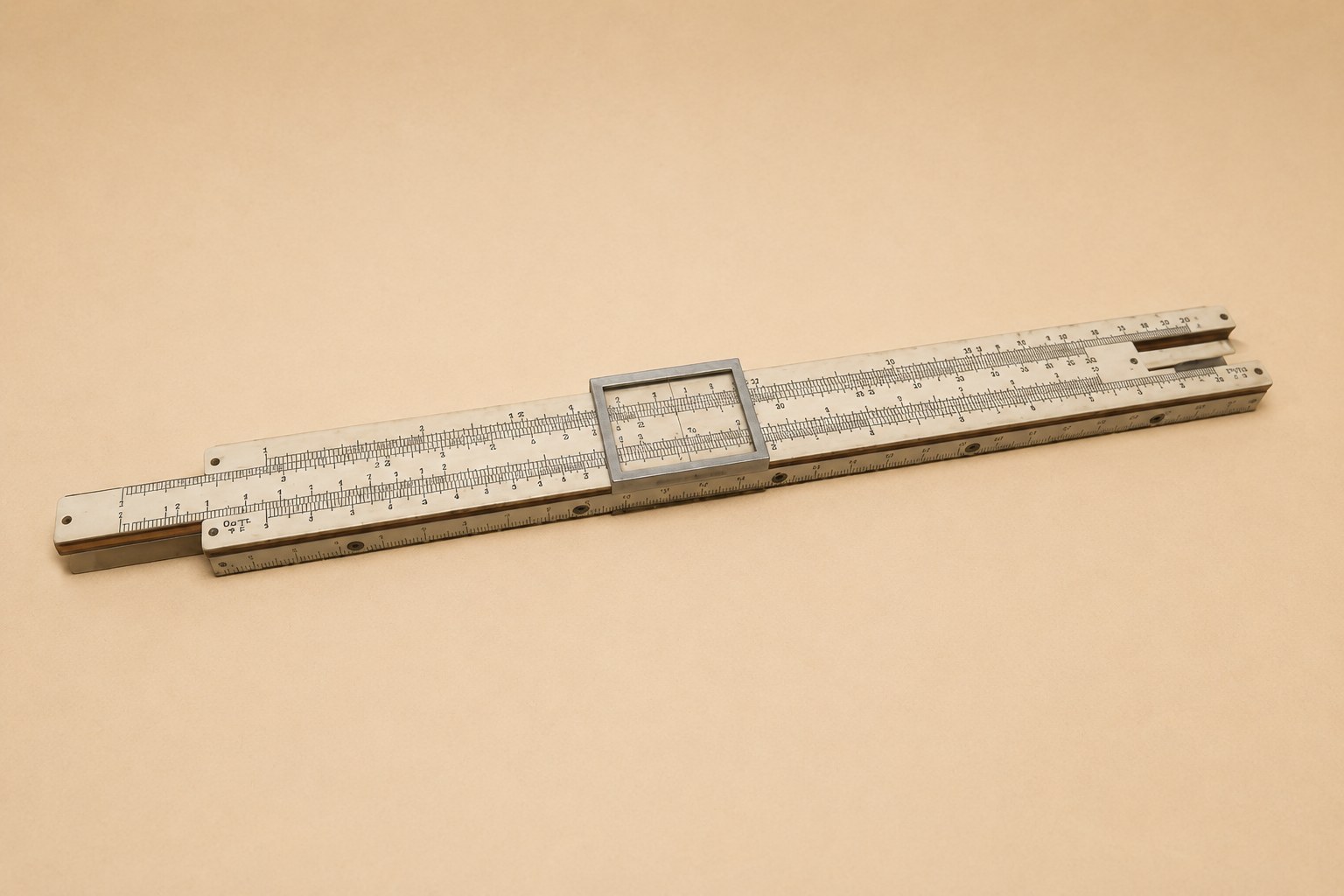
This is an A.W. Faber "Castell" model 360 slide rule, 280 mm long with a 25 cm working scale, the classic desk length carried by engineers across Europe and America. Its body is pearwood, faced on every working surface with precision-engraved celluloid: a construction Faber pioneered, laminating celluloid onto wooden rules from 1887 and adding the metal-rimmed glass cursor in 1889. Hidden inside the stock, longitudinal metal strips, protected under D.R. Patent 206428 of 1908, brace the wood against humidity, the great enemy of wooden instruments.
The front face carries the maker's marking 360 * A.W. FABER "CASTELL", the Castell name flanked by the two lying castles of the Castell coat of arms, with patent numbers 206428 and 365637. The scales follow the Mannheim arrangement: A and D on the stock, B and C on the slide, with sine, logarithm, and tangent scales on the slide's reverse, read through cut-out windows. The rail ends are labelled Quot. +1 and Prod. -1, a Faber refinement allowing quotient and product calculations without re-setting the slide. An inch scale runs along the top edge, centimetres along the bottom.
Turn it over and the story gets more specific: the back carries a full English-language conversion table: weights of iron, steel, copper, brass, lead, zinc, and aluminium; Imperial, US, and metric conversions; horsepower and kilowatts; the geometry of circles and spheres. Faber printed these tables in the language of the destination market, so this rule was made for export to Britain or North America, not for German engineers at home. The cursor frame and the stock are both stamped MADE IN BAVARIA.
The Maker
The firm behind this rule began with pencils. In 1761, cabinet-maker Kaspar Faber started producing pencils in Stein, near Nuremberg, founding what is now one of the oldest manufacturing companies in the world. His great-grandson Lothar von Faber built it into a global concern in the nineteenth century: standardising the pencil grades and the hexagonal shape still used today, opening branches in New York, London, and Paris, and even buying a Siberian graphite mine to secure his supply.
Slide rules came later: production began in 1892 at the company's factory in Geroldsgrün, Bavaria, and Faber grew into one of the world's dominant slide rule makers, a position it held until electronic calculators ended the trade in the late 1970s. The "Castell" in the name records a wedding: in 1898 Lothar's granddaughter and heiress Ottilie von Faber married Count Alexander zu Castell-Rüdenhausen, founding the Faber-Castell family that still owns the company. The transitional branding on this rule ("A.W. Faber" with "Castell" in quotation marks between the heraldic castles), together with the "Made in Bavaria" stamp places its manufacture in approximately 1927 to 1934. That dating is an inference from branding chronology assembled by slide rule historians, not from a factory record for this individual rule, but collectors' dating studies of Faber markings make the window reasonably firm. Pearwood construction itself dates Faber rules to the 1920s onward, consistent with this estimate.
The World It Came From
The mathematics inside this object is older than the machine age. John Napier published his logarithms in 1614; within a decade, William Oughtred realised that two logarithmic scales sliding against each other could multiply numbers mechanically. The modern four-scale layout and glass cursor were devised in 1859 by Amédée Mannheim, a French artillery officer, which is why rules like this one are still called "Mannheim" rules.
For the next century the slide rule was simply how technical work was done. It computed artillery tables in two world wars, stress calculations for the first jet aircraft, and engineering work through the early space programme. Then, with startling speed, it vanished: affordable scientific calculators such as the TI-30 of 1976 made three centuries of logarithmic craftsmanship obsolete in roughly five years. Faber-Castell, the last great holdout, ended slide rule production in the mid-1970s.
This Copy
This example survives in good working order. The celluloid faces are clear and legible, the engraved graduations crisp, and the pearwood shows no warping, meaning the patented metal bracing has done its quiet job for nearly a century. The paper conversion table on the reverse is age-yellowed but fully readable. The aluminium-framed glass cursor is present and runs true; no carrying case survives with the rule.
The English back-table marks this as an export instrument, and given the 1927–1934 manufacturing window it was most likely sold to a working engineer or technical professional in Britain, a plausible reading of the evidence rather than a documented fact, as no ownership marks identify its first user.
Why It Matters
Every era has a tool that defines how its people thought, and for the industrial twentieth century that tool was the slide rule. This one captures a precise moment: a 170-year-old pencil dynasty mid-way through becoming Faber-Castell, stamping its new aristocratic name in quotation marks as if still trying it on; a German factory building instruments for English-speaking engineers between two world wars; and a calculating technology at its absolute peak, twenty years of refinement still ahead of it and total extinction forty years away. It still works. It will work in another century, which is more than can be said for any calculator that replaced it.
References
- A.W. Faber / Castell 360, andtheugly.com
- Faber-Castell Slide Rule Gallery, International Slide Rule Museum
- Suggestions for Dating Faber-Castell Slide Rules (T. Catlow), International Slide Rule Museum
- A W Faber Castell type 360 slide rule, Powerhouse Collection
- Faber-Castell, Wikipedia
- Faber-Castell family, Wikipedia
- Lothar von Faber, Wikipedia
- Faber, Faber-Castell, Germany, Following the Rules
- Slide rule, Wikipedia
- Amédée Mannheim, Wikipedia
- William Oughtred, Wikipedia
- John Napier, Wikipedia
- TI-30 scientific calculator, Wikipedia
- A. W. Faber Mannheim Simplex Slide Rule, Smithsonian Institution