Books & Literature
Lady Agnes and Other Poems
Thirty-one poems by a man history declined to remember: the first and only edition of an unknown Manchester poet's lifework, 1878, with a preface that fires one perfect shot at literary fashion.

A Private Archive of Antiques & Historical Objects
Books & Literature
Thirty-one poems by a man history declined to remember: the first and only edition of an unknown Manchester poet's lifework, 1878, with a preface that fires one perfect shot at literary fashion.
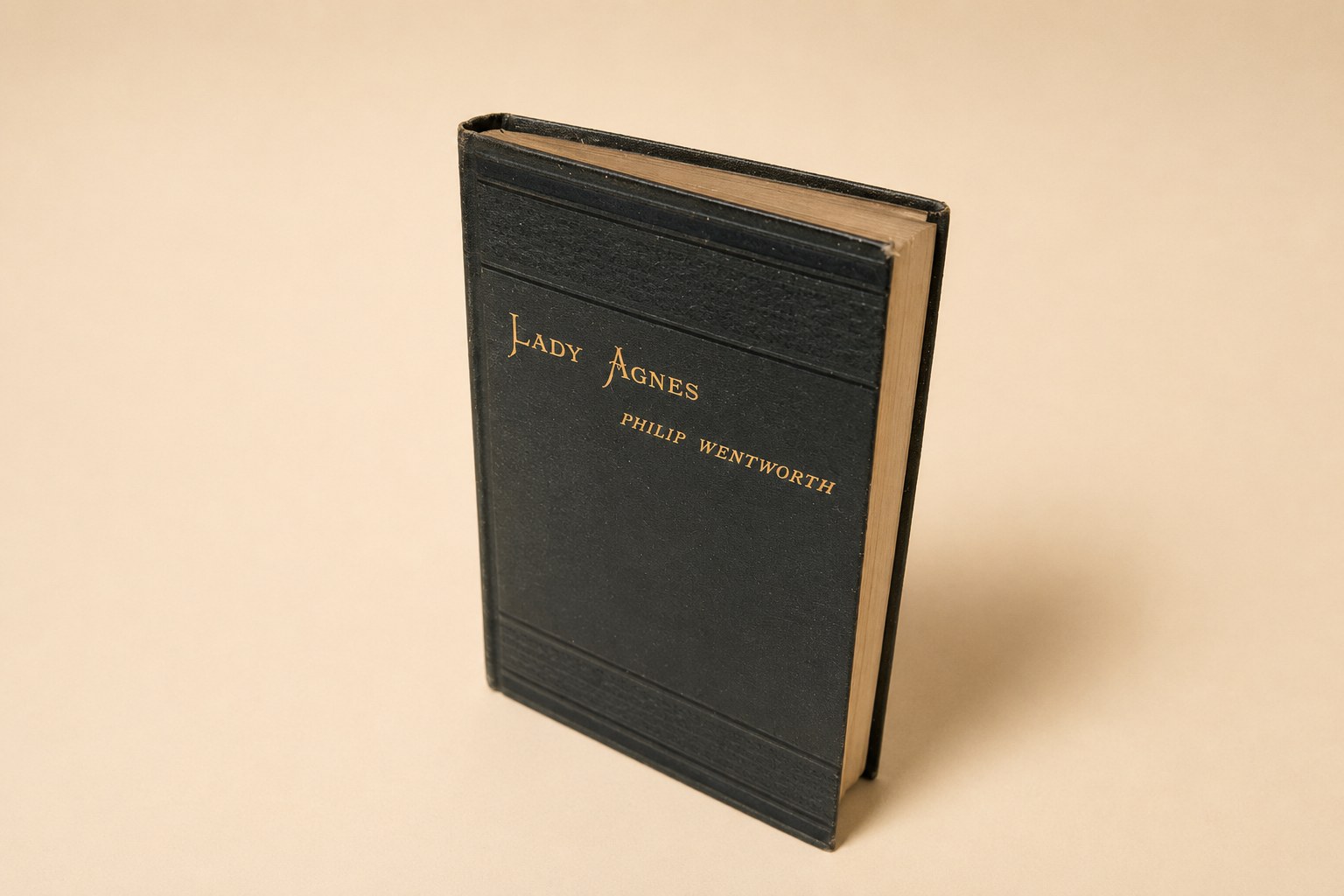
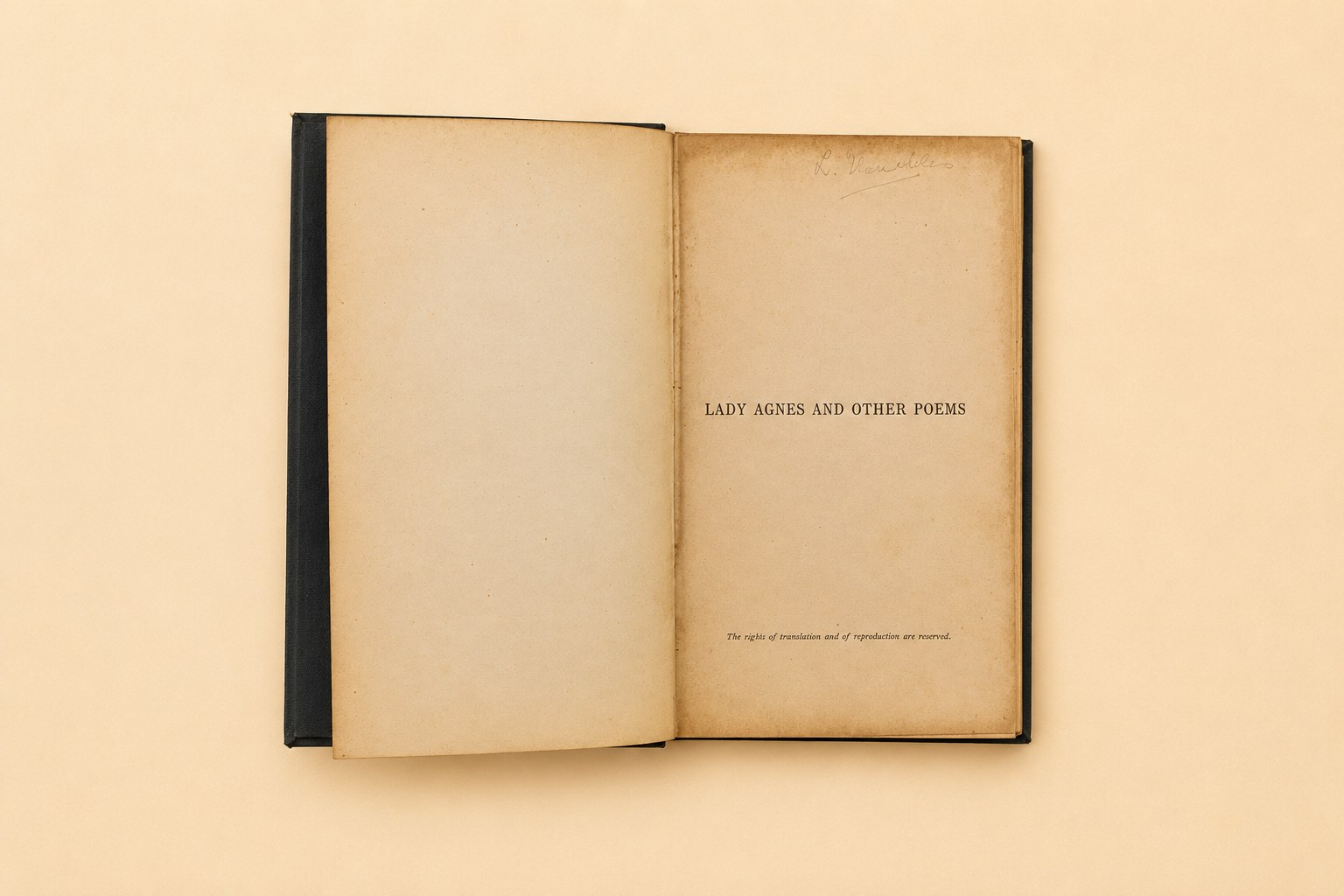
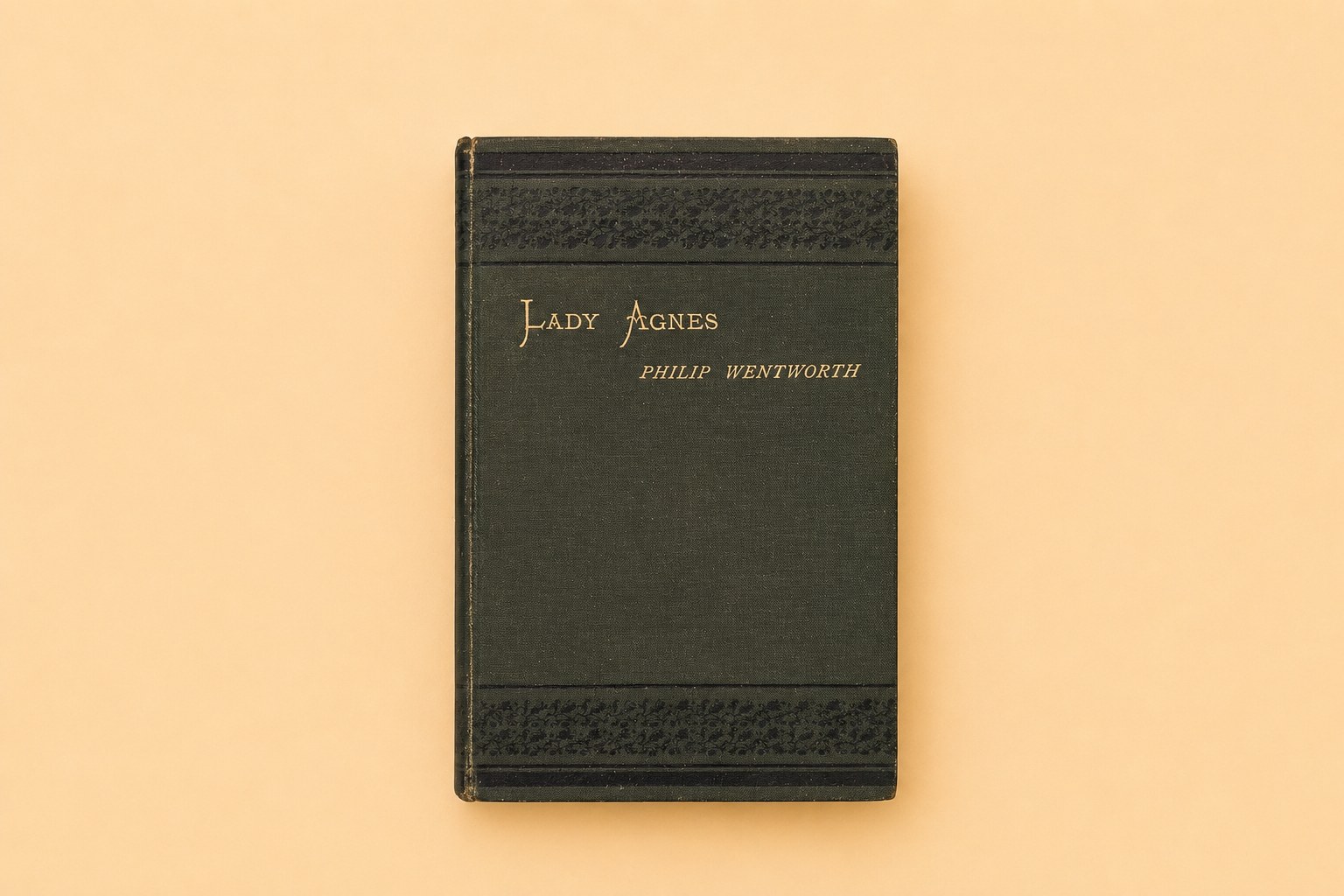
In February 1878, at Derby Terrace, Queen's Road, Manchester, a man named Philip Wentworth finished the preface to his first and only book of poems. He hoped, he wrote, "to secure, if possible, a place in the esteem of worthy judges of literature." He did not get one. No literary dictionary records him; no second book followed. And yet here the book still is, nearly 150 years later (green cloth, gilt title, a pencilled owner's name on the half-title), having quietly outlasted every fashionable reputation its author envied. There is something close to a moral in that.
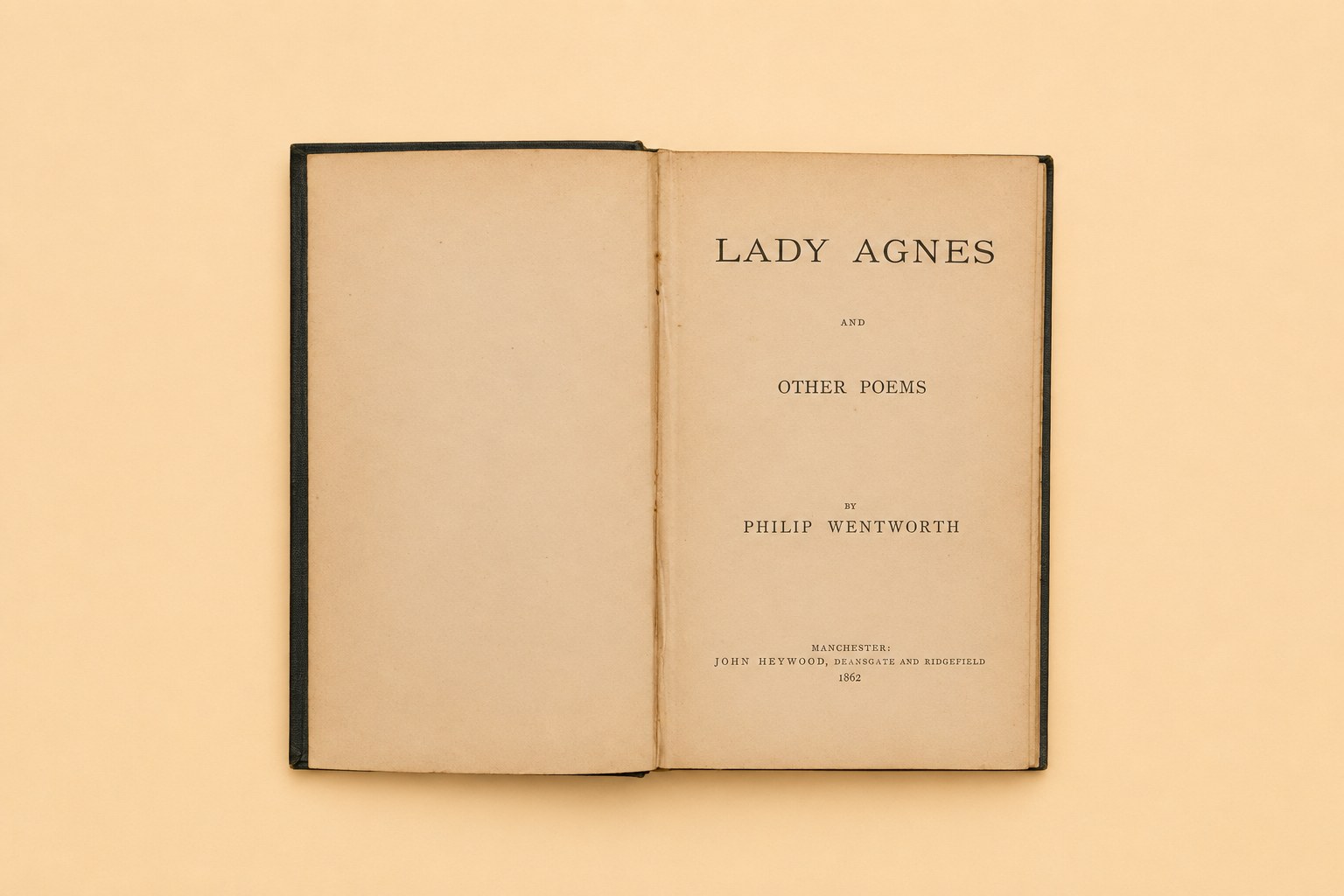
Lady Agnes and Other Poems was published in 1878 by John Heywood of 141–143 Deansgate, Manchester's great Victorian publisher-printer-stationer, who produced the book at his own Excelsior Printing and Stationery Works. It is a small octavo of 92 pages in dark green pebbled cloth, gilt-lettered, containing thirty-one poems. The dedication page carries one unexplained line of Latin, In te Domine speravi non confundar in aeternum, from Psalm 31 (In thee, O Lord, do I put my trust; let me never be put to confusion): an act of faith placed before the work, addressed past every worthy judge of literature to a higher court.
The range is the charm. The title ballad Lady Agnes sits beside religious verse, an Ode to a Pin, poems on The Indian Empire and The Marriage of the Prince of Wales, a meditation on Tennyson's In Memoriam, a Dream of the Devil, and, most revealing, A Vision of Voltaire. Anticipating offence at the Voltaire poem, Wentworth's preface delivers the book's best line: "abject deference to insincerity in literature, simply because it happens to be fashionable, is a crime that nothing can palliate."
Philip Wentworth is a genuine unknown, and that is precisely his interest. No standard reference records him; what we know comes entirely from the book: his address, his Latin, his years of work on the collection ("many years," he says), his nettled independence of opinion, and his taste; the ballad form of the title poem was then in fashionable revival under Rossetti and the Pre-Raphaelites. The portrait that emerges, by inference rather than documentation, is of a well-read provincial Victorian intellectual: devout, opinionated, alert to Empire and Establishment, writing through Manchester's November fog. His publisher was no vanity press (Heywood was a substantial regional house, at times printer to the Government), but no second Wentworth title has ever been traced.
The 1870s saw an enormous undergrowth of regionally published Victorian verse: schoolmasters, clergymen, merchants, and clerks paying their respects to the muse through local printing houses. Almost all of it vanished. What survives is now prized by historians precisely because it is unfiltered, poetry by the audience rather than for it, recording what an ordinary educated provincial actually thought about Voltaire, the Royal Family, the Indian Empire, and the rules of prosody. Books like this are the Victorian inner life with the lid off.
The half-title carries a careful pencil inscription: L. Venables, a north-western surname of Norman antiquity, common in Cheshire since the eleventh century, though whether that lineage and this owner connect is unknowable. The contents pages are detached but fully present; the cloth and gilt remain good. As far as can be established this is the only edition the book ever had, and surviving copies are rare.
Every other book in this collection succeeded. This one didn't, and that is its value. It preserves the courage of an unknown man who spent years on ninety-two pages, paid his respects to God on the dedication page and his disrespects to literary fashion in the preface, and was forgotten anyway. Collections need their famous objects; they also need one entry for everyone history declined to remember. Philip Wentworth, against all odds, has secured his place in the esteem of at least one worthy judge of literature: whoever is reading this.
Provenance
Pencil inscription 'L. Venables' on half-title; owner untraced. Self-dating: 1878 imprint, preface dated Derby Terrace, Queen's Road, Manchester, February 1878. Only edition; surviving copies rare.
England South
Forty years of sketch-books opened in the year England needed them most: the first volume of Sydney R. Jones's illustrated journey through the southern counties, from London to the very end of Cornwall (1948).
England West
The trilogy's longest journey: Thames to Hadrian's Wall through Cotswold wool churches, Shakespeare country, the Marches, and the industrial North. The richest of the three volumes in architectural range (1950).
England East
The farewell volume: Jones closes his life's work with a journey from the Thames to the Scottish border, saluting Durham coalminers alongside Northumbrian castles, under an epigraph about ashes and graves (1954).