Books & Literature
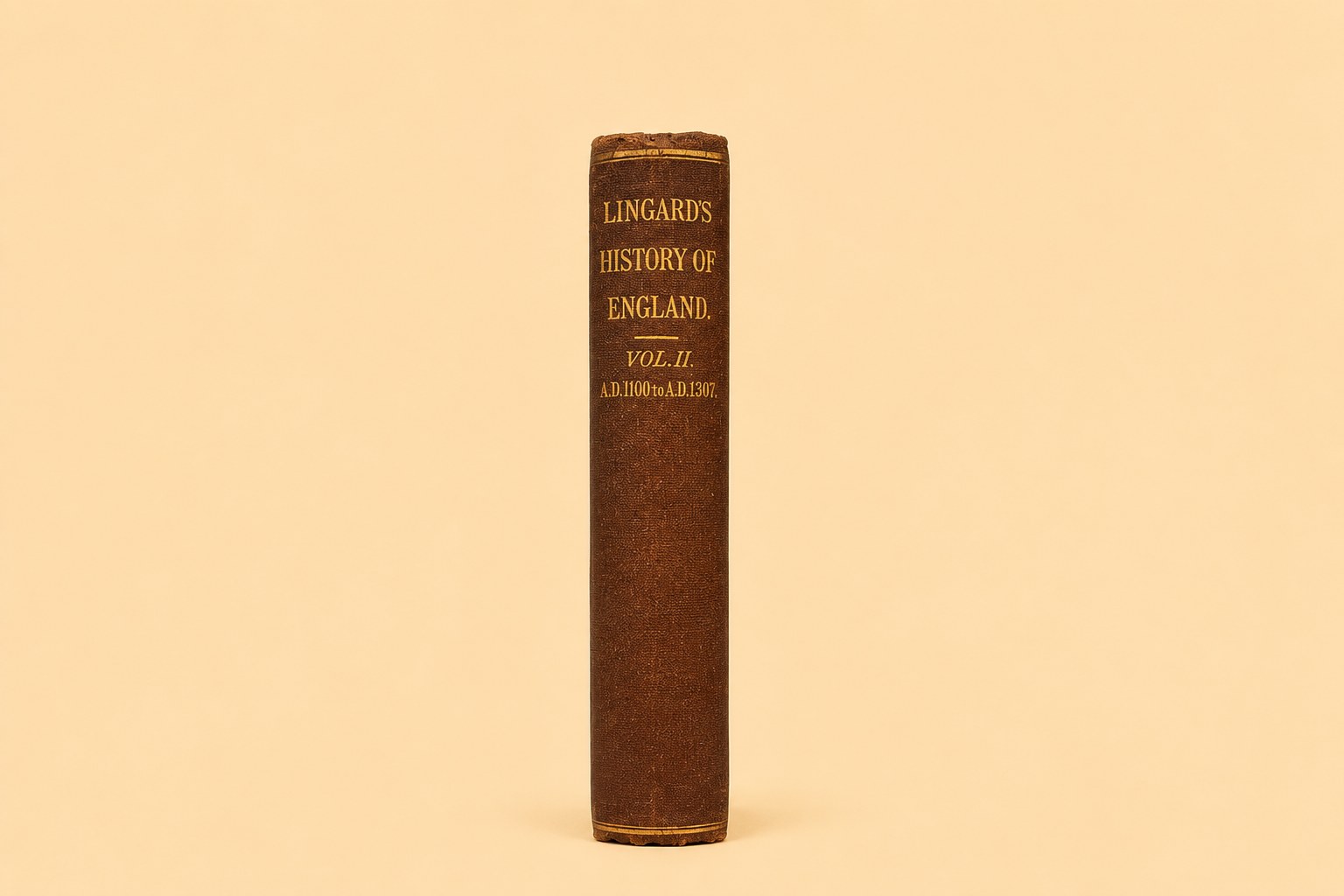
Lingard's History of England, Vol. II
Volume II of Lingard's history — Henry I to Edward I: Becket, Magna Carta and the first parliaments, told without the Whig gloss.


A Private Archive of Antiques & Historical Objects
Books & Literature
Volume II of Lingard's history — Henry I to Edward I: Becket, Magna Carta and the first parliaments, told without the Whig gloss.
Two centuries that built the English state — and broke, repeatedly, on the rock of the Church. Volume II runs from the consolidation of Norman rule to the death of Edward I, and its recurring drama is the collision of kings with an international Church at the height of its medieval power.
It opens with Henry I and the English form of the Investiture Controversy, passes through the ruinous civil war of Stephen and the Empress Matilda (the "Anarchy"), and reaches the formidable Henry II — founder of the Angevin empire and reformer of the common law — whose reign is dominated by his struggle with his former chancellor Thomas Becket, Archbishop of Canterbury, murdered at the altar in 1170 and canonised within three years. Then come Richard the Lionheart and the Third Crusade; King John, the loss of Normandy, the quarrel with Pope Innocent III and the interdict, and the sealing of Magna Carta at Runnymede in 1215; the long reign of Henry III and the Second Barons' War led by Simon de Montfort, whose 1265 assembly is a landmark of representative government; and the masterful, conquering reign of Edward I — the subjugation of Wales, the wars in Scotland, and the Model Parliament of 1295 — closing in 1307.
This is the England of an undivided Latin Christendom, and its great confrontations — Becket against Henry II, John against Innocent III — are precisely the episodes a Catholic historian was expected either to crow over or to be embarrassed by. Lingard does neither. He narrates the Becket quarrel from the documents, allowing the archbishop his courage and the king his grievance, and it is exactly this refusal to play advocate that made even hostile readers concede his fairness — while his Whig critics, like the Edinburgh Review's John Allen, watched for the moments when, as Allen complained, his "passions are warmed whenever the honour of his Church is at stake."
Magna Carta, the murder of Becket, the first representative parliaments: Volume II covers the medieval foundations of English law and liberty that the Whig tradition claimed as its own origin story. To read them through Lingard — who sees the same events without the Protestant-providential gloss — is to watch the period's meaning quietly contested. It is the high-medieval keystone of the set.
Provenance
Sixth Edition; Charles Dolman, London, 1854–55. One of nine volumes held of the ten-volume set (the set lacks only Vol. IX, A.D. 1660–1680). No ownership inscription noted. Part of a 27-book lot acquired February 2026; cost in the Ledger.
England South
Forty years of sketch-books opened in the year England needed them most: the first volume of Sydney R. Jones's illustrated journey through the southern counties, from London to the very end of Cornwall (1948).
England West
The trilogy's longest journey: Thames to Hadrian's Wall through Cotswold wool churches, Shakespeare country, the Marches, and the industrial North. The richest of the three volumes in architectural range (1950).

England East
The farewell volume: Jones closes his life's work with a journey from the Thames to the Scottish border, saluting Durham coalminers alongside Northumbrian castles, under an epigraph about ashes and graves (1954).