Books & Literature
A Preface to Shakespeare
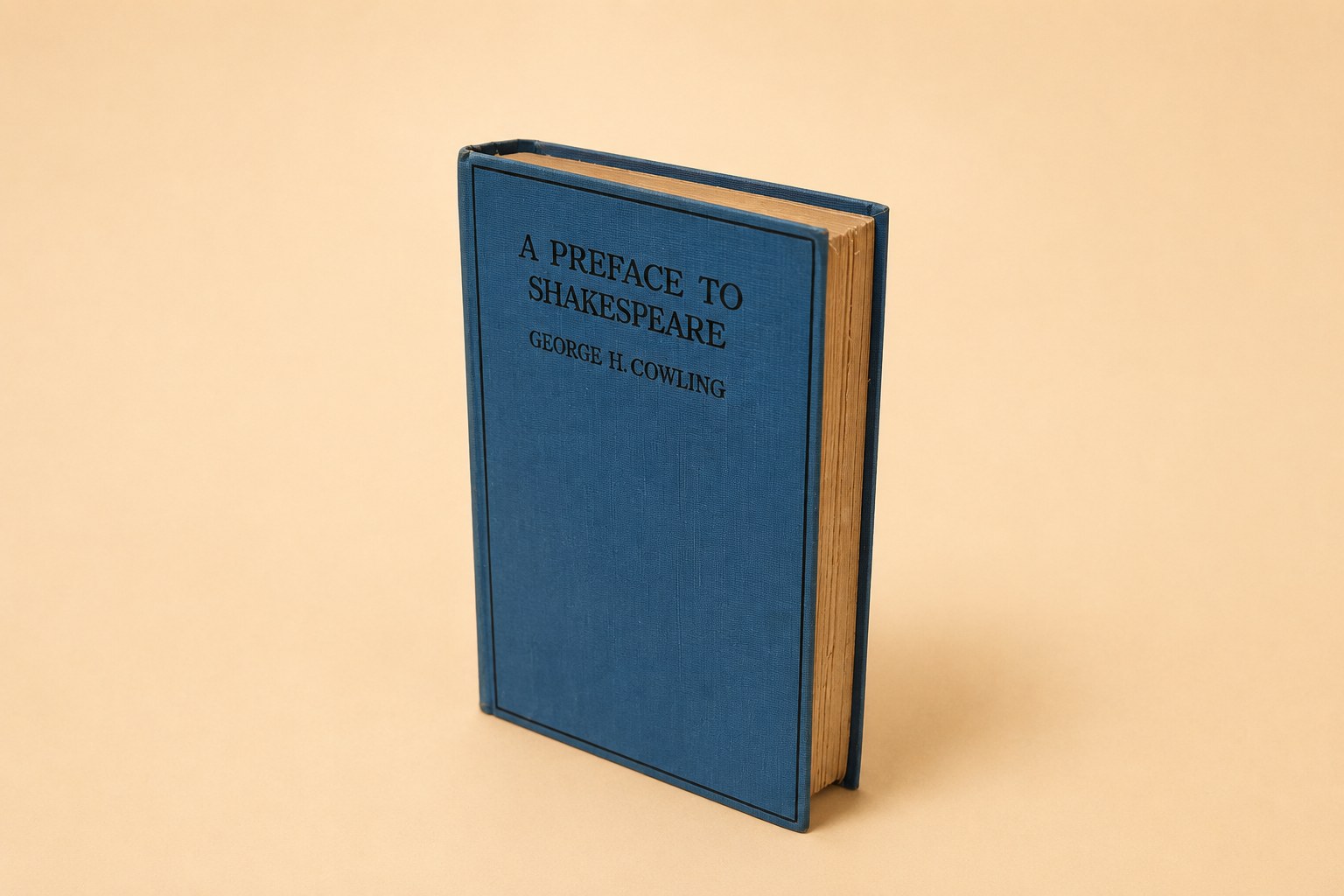
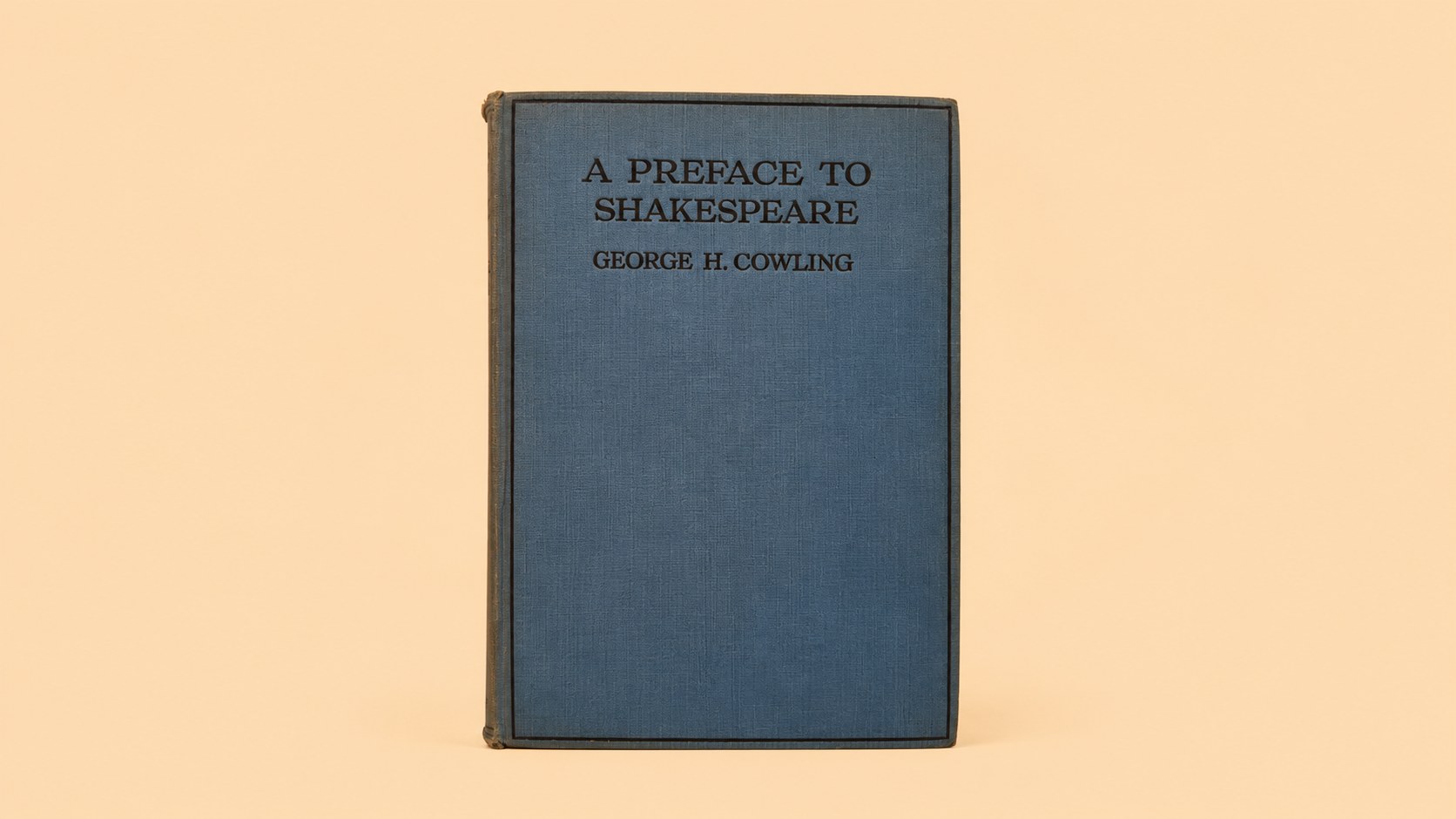
A 1925 first-edition Shakespeare primer by George H. Cowling — written at Leeds in the years he worked alongside Tolkien — bearing the bookplate of a 'James Craigie, M.A.'
A Private Archive of Antiques & Historical Objects
Books & Literature
A 1925 first-edition Shakespeare primer by George H. Cowling — written at Leeds in the years he worked alongside Tolkien — bearing the bookplate of a 'James Craigie, M.A.'
This quiet blue volume is a scholar's attempt to do a difficult thing simply: to introduce Shakespeare to the general reader without either antiquarian fustiness or fashionable theory. Its author, George Herbert Cowling, wrote it at the University of Leeds in 1924 — and behind that plain fact sits one of the better pieces of literary-historical luck in the collection's bookshelf.
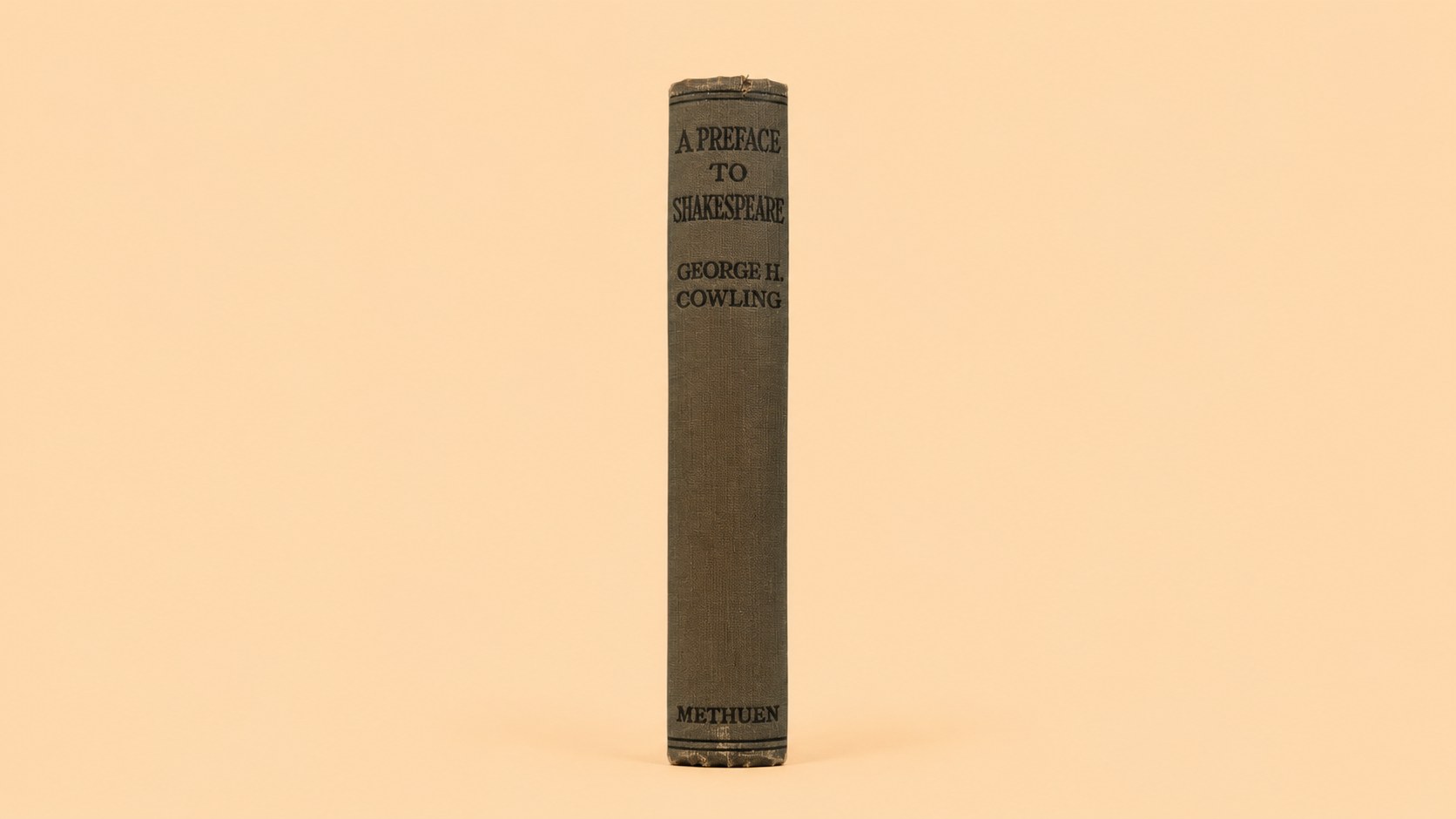
The book is A Preface to Shakespeare by George H. Cowling, published by Methuen & Co. of London, First Published in 1925 and printed by Butler & Tanner of Frome and London. It is a blue cloth octavo, black-lettered, of some 161 pages, illustrated with well-chosen plates: the Swan Theatre after de Witt, the Globe from Visscher's 1616 panorama of London (and a 1921 conjectural reconstruction of its stage), Shakespeare's Stratford birthplace and monument, the First Folio title page with the Droeshout portrait, and the Chandos portrait. The nine chapters move from Shakespeare's England and The Elizabethan Theatres through the life, the text, the poems and the plays to The Genius of Shakespeare. In his preface Cowling promises “a sane view of the subject, eschewing both antiquated opinions and modern follies,” and thanks the Arden editor Professor R. H. Case for reading the proofs.
Cowling (1881–1946) was a Leeds-born scholar of English language and literature, and an authority on Shakespeare, Milton and Blake; his Music on the Shakespearean Stage (1913) was the first study of its subject. The telling detail is where he was. At Leeds in the early 1920s the small English department included J. R. R. Tolkien and E. V. Gordon — who together produced their famous edition of Sir Gawain and the Green Knight in 1925 — and Cowling worked alongside them, succeeding to a Readership when Tolkien left for the Oxford chair that same year. So this unassuming primer comes straight out of the Leeds of the Tolkien years — and the connection ran deeper than the common room. The Cowling and Tolkien families remained lifelong friends: the Cowlings stayed with the Tolkiens in 1938, and in 1955, after Cowling's death, Tolkien gave his widow Muriel signed copies of all three volumes of The Lord of the Rings. Cowling himself went on in 1928 to the Chair of English at the University of Melbourne, where in 1935 he published an article in The Age asserting that literature of worth could not be produced in Australia — the provocation that drew P. R. Stephensen's The Foundations of Culture in Australia in reply and sits directly upstream of A. A. Phillips's coining of the "cultural cringe" in 1950. A minor Shakespeare primer's author, twice at the hinge of literary history: once beside Tolkien, once against Australia.
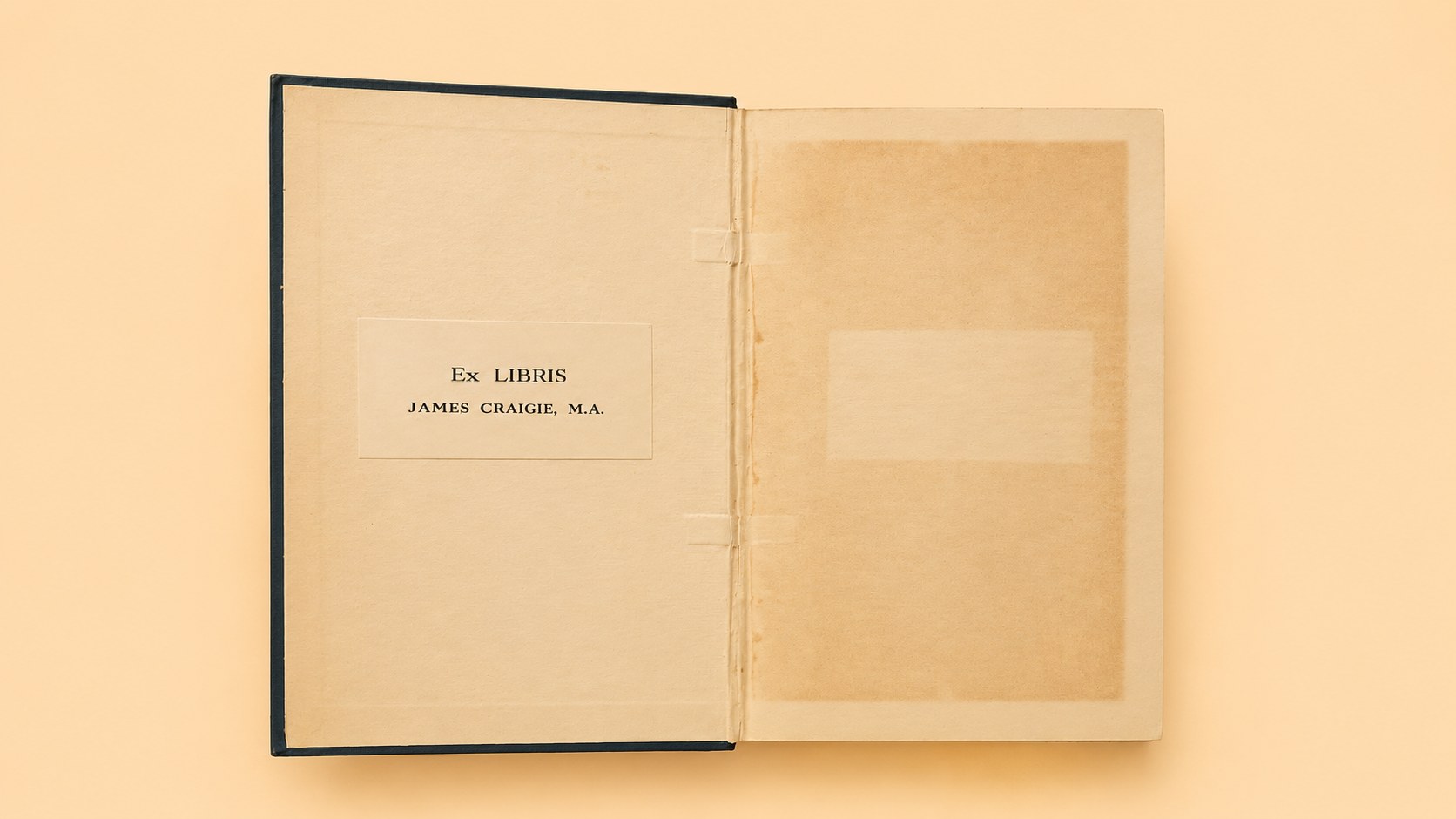
The volume is in good condition, the blue cloth a little sunned and the spine ends frayed, with light foxing — honest wear for a working academic book a century old. Its distinguishing feature is the bookplate on the front pastedown: Ex Libris James Craigie, M.A. A scholar of exactly that name, James Craigie, edited the works of King James VI and I — the Basilicon Doron (2 vols, 1944–50), the Poems (2 vols, 1955–58), and the Minor Prose Works (1982, seen through the press by Alexander Law) — for the Scottish Text Society; that such a man owned a Shakespeare handbook is entirely plausible, but the identification can be offered only as a possibility, not a certainty. A second thread: a James Craigie also compiled the standard two-volume Bibliography of Scottish Education — the profile of a Scottish schoolmaster-scholar fits the plain "M.A." of the bookplate exactly — though whether the educationist and the STS editor are one man is itself unproven. The decisive source is likely the front matter of the 1982 Minor Prose Works, which by STS convention should carry a memoir of its late editor: dates, career, and degrees enough to test the bookplate. The flyleaf also carries the pencilled price-codes of the second-hand book trade through which it travelled.
As a text it is a competent, likeable specimen of the inter-war effort to make Shakespeare scholarship public — the Methuen “preface” as a form. Its real interest, though, is contextual: a book written inside the Leeds English school at the precise moment Tolkien and Gordon were there, by a colleague who would carry English studies to the other side of the world, and later owned (perhaps) by a notable editor of a Scottish king's poetry. A modest book, but unusually well connected — exactly the kind of quiet thread this collection likes to pull.
Provenance
Methuen & Co., London; 'First Published in 1925' (the preface dated 'Leeds, 1924'); first edition, printed by Butler & Tanner of Frome and London. Bookplate on the front pastedown: 'Ex Libris James Craigie, M.A.' — possibly the Scottish scholar James Craigie who edited King James VI's works for the Scottish Text Society (Basilicon Doron 1944–50; Poems 1955–58; Minor Prose Works 1982, seen through the press by Alexander Law), and possibly also the compiler of the standard Bibliography of Scottish Education — both UNCONFIRMED inferences. Decisive check: the memoir of the late editor expected in the 1982 STS Minor Prose Works front matter. Pencil bookseller's pricing notations on the flyleaf ('(5/-)', '2/6', etc.). One of a group of 27 books acquired together in February 2026 (same lot as the Bridges, Coghill, Gordon and Smiles volumes); acquisition cost in the Ledger.
England South
Forty years of sketch-books opened in the year England needed them most: the first volume of Sydney R. Jones's illustrated journey through the southern counties, from London to the very end of Cornwall (1948).
England West
The trilogy's longest journey: Thames to Hadrian's Wall through Cotswold wool churches, Shakespeare country, the Marches, and the industrial North. The richest of the three volumes in architectural range (1950).
England East
The farewell volume: Jones closes his life's work with a journey from the Thames to the Scottish border, saluting Durham coalminers alongside Northumbrian castles, under an epigraph about ashes and graves (1954).