Opening
On 22 November 1947, in a Cornish town still living on ration books, a football club barely eighteen months old had a brass plaque engraved, fixed it to a precision weather instrument, and presented it to a man named A.R. Wellington. Nobody now remembers who he was or what he did to deserve it. The barometer remembers for them: name, club, and date, polished into brass and hanging on the wall ever since.
The Object
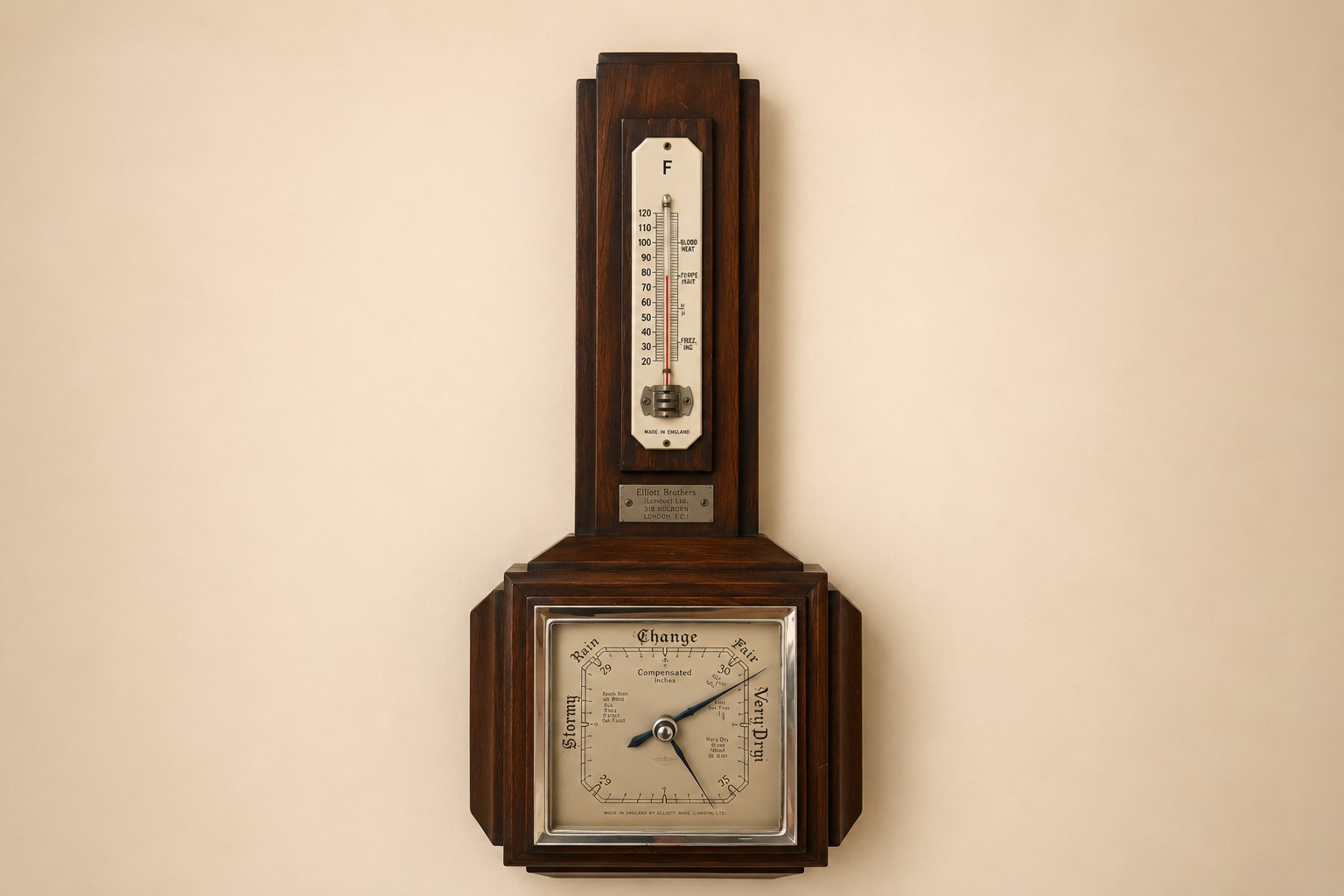
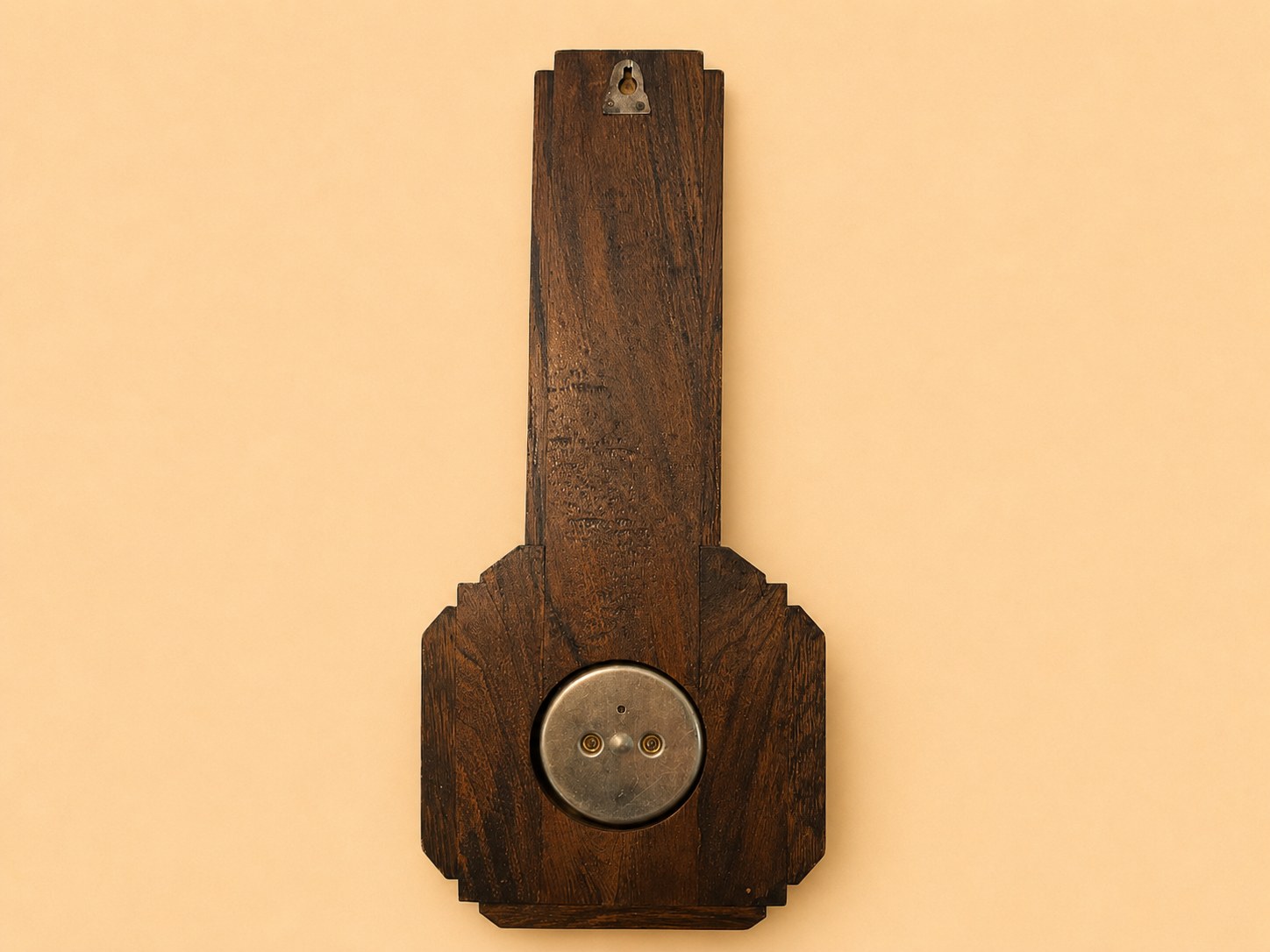
This is a wall-mounted combination weather station by Shortland Brothers of England: a Fahrenheit spirit thermometer above and an aneroid forecasting barometer below, mounted on a single dark oak panel in the stepped, chamfered Art Deco style of British domestic instrument-making in the 1930s and 40s. The barometer sits behind a square polished-chrome bezel with rounded corners; between the two instruments, on a small recessed shelf, sits the brass dedication plaque.
The thermometer face is white enamel, octagonal, with a scale running 20°F to 120°F and an old-fashioned charm in its labels: Freezing, Temperate, Summer Heat, and Blood Heat: reference points inherited from nineteenth-century British thermometer convention and still being printed on instruments after the Second World War. The barometer dial is cream with brown gothic forecast lettering, the winged SB badge of Shortland Brothers at its centre, and the markings MADE IN ENGLAND and BRITISH PAT. APPLIED FOR along its lower edge. Its pressure scale runs from 28 to 31 inches of mercury, the full practical range of British weather, from deep storm-bearing depression to settled anticyclone.
The Maker
Shortland Brothers were British makers of domestic meteorological instruments under the SB winged badge, producing aneroid barometers and thermometers in oak Art Deco cases of exactly this type from at least the early 1930s — the firm's surviving Catalogue No. 34 (c. 1934) shows the range. Collectors commonly associate the firm with the Smiths instrument group ("Shortland Smiths"), and a later firm, Shortland Bowen Instruments Limited, is represented in the Science Museum Group collection — but the documentary record of these corporate relationships is thin, and even the principal collector source declines to state when or how the Shortland–Smiths affiliation began. The lineage is reported here as association, not established succession. Collectors sometimes misread the SB badge as Short & Mason, the famous Walthamstow firm behind the Stormoguide, but the two companies are entirely distinct.
The "BRITISH PAT. APPLIED FOR" marking is a useful dating witness: it shows the dial design was new enough that its patent had not yet been granted when this instrument left the factory, consistent with the 1947 date on the plaque. No granted patent for this dual-hand dial has yet been traced; a search of the UK patent record (Espacenet / IPO, c. 1944–48, applicant Shortland) is the outstanding research step, and would tighten the dating if found.
The World It Came From
Before the radio forecast became ritual and long before satellites, the hallway barometer was how a household read the sky's intentions. The technology inside is elegant: an aneroid mechanism, a sealed, evacuated metal capsule invented by Lucien Vidi in 1844, that breathes with the atmosphere, its tiny flexing amplified through levers to a pointer. No dangerous mercury column, no liquid at all; aneroid is Greek for "without liquid."
This dial adds a genuinely clever refinement: two hands and two interlocking sets of forecasts. The instruction line reads RISING, HAND MOVES TO RIGHT, READ BLACK FORECAST / FALLING, HAND MOVES TO LEFT, READ RED FORECAST. The same pressure reading delivers a different prediction depending on whether the air is rising toward it or falling toward it, encoding the meteorologist's first rule, that the direction of pressure change matters as much as the number. Short & Mason's Stormoguide had pioneered direction-aware forecasting in the 1920s; this is Shortland's own patented domestic answer to the same insight.
This Copy
The plaque reads: FROM / SALTASH UNITED F.C. / TO / A.R. WELLINGTON / 22 NOV: 1947.
Saltash United, "the Ashes", is a Cornish football club on the west bank of the Tamar, facing Plymouth across the water. Football in Saltash goes back to the 1890s under the old name Essa, but the club had disbanded during the Second World War and reformed as Saltash United for the 1946–47 season. The reborn club's first competitive fixture was a 7–1 win over Landulph on 31 August 1946; when this plaque was engraved in November 1947, the club was in roughly its eighteenth month, playing in the Plymouth & District League, four years away from joining the South Western League as a founder member — a league it would win outright in 1953–54.
Who A.R. Wellington was is not recorded in any public source located so far. The likeliest reading (an inference, not a documented fact) is that he was a club official, founder, or benefactor, honoured mid-season in the club's second year. The gift itself follows a thoroughly British mid-century convention: barometers, clocks, and inkstands were the standard tokens of civic and sporting gratitude. The instrument remains in good order, its dial legible and its mechanism intact.
Why It Matters
Most surviving domestic barometers are anonymous: well-made, mass-produced, and mute about their own lives. This one talks. It fixes a specific gesture of gratitude to a specific Saturday in post-war Cornwall: austerity Britain, rationing seven years from ending, a community football club reconstituting itself after the war and already finding the means and the will to honour one of its own. As an instrument it is a competent and attractive piece of late-1940s British manufacture with a genuinely interesting patented dial. As a document it is something rarer: a small brass-plated act of kindness that outlived everyone who witnessed it.
References
- Shortland Smiths catalogues and patent notes, Analog Weather
- Shortland Bowen Instruments Limited, Science Museum Group Collection
- Short and Mason Limited, Science Museum Group Collection
- Short and Mason, Grace's Guide
- Saltash United F.C., Wikipedia
- Club History, Saltash United Football Club
- Saltash United, Football Club History Database
- Aneroid barometer, Wikipedia
- Barometer, Wikipedia
- Lucien Vidi, Wikipedia
- Atmospheric pressure, Wikipedia