Optics & Photography
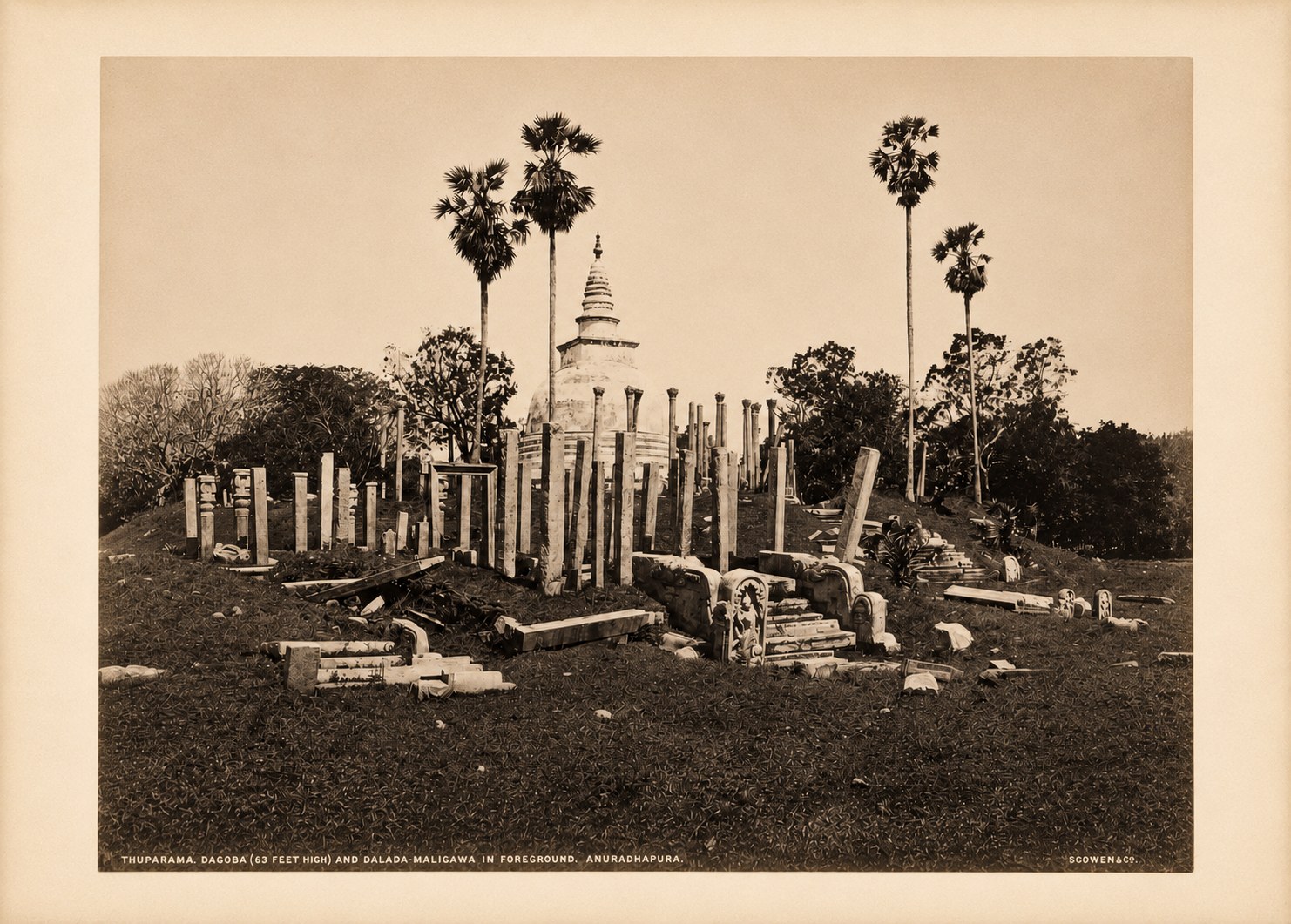
Thuparama Dagoba & Dalada Maligawa, Anuradhapura
Scowen & Co.'s albumen view of Thuparama — the first stupa built in Sri Lanka — ringed by the leaning pillars of its ancient relic-house and a lost Temple of the Tooth.
A Private Archive of Antiques & Historical Objects
Optics & Photography
Scowen & Co.'s albumen view of Thuparama — the first stupa built in Sri Lanka — ringed by the leaning pillars of its ancient relic-house and a lost Temple of the Tooth.
A white bell of a stupa rising behind a field of leaning stone columns, tall palms overhead, carved slabs and a moonstone tumbled in the grass. Scowen & Co. titled this view THUPARAMA DAGOBA (63 FEET HIGH) AND DALADA-MALIGAWA IN FOREGROUND, ANURADHAPURA, and in that one line it gathers up two of the oldest sacred stories on the island: the first stupa ever built in Ceylon, and the ruins of an early shrine to the Buddha's tooth.
An albumen silver print — a glass-plate negative contact-printed onto egg-white paper, the standard fine print of the Victorian era. The title and the studio credit Scowen & Co. are printed into the negative along the lower edge (the credit at lower right), so the attribution is carried in the image itself rather than added by a later hand. The card mount bears a pencilled album number, 95, marking it as a print once bound into a Victorian album and since dispersed. Its companion in this collection, the Sacred Bo Tree steps, came out of the same group.
The firm is Charles Thomas Scowen's Scowen & Co., founded in Kandy in 1876 with a later branch in Colombo, and widely regarded as the finest commercial studio in nineteenth-century Ceylon. Its archaeological views of Anuradhapura were made in the years just before the formal excavations of the 1890s, when the ancient city was still half-reclaimed by jungle. When Scowen left the trade in the mid-1890s, the Colombo Apothecaries Co. acquired his negatives and kept printing them; surviving Scowen Anuradhapura prints are held at the Getty and in the Online Archive of California finding aid of Sri Lankan views, among others. (See the companion Bo Tree entry for the fuller account of the maker.)
The dome is Thuparamaya, the first dagoba built in Sri Lanka, raised by King Devanampiya Tissa in the third century BC, immediately after the missionary Mahinda — son of the emperor Ashoka — brought Buddhism to the island. It was built to enshrine the Buddha's right collarbone relic, and so stands at the very beginning of the island's Buddhist architecture.
The leaning stone columns that fill the foreground are the great clue. Thuparama was later enclosed in a vatadage, a circular relic-house in which concentric rings of stone pillars carried a wooden roof over the stupa; those rings, toppled and thinned by time, are the forest of slanting columns Scowen captured. The bell-shaped dome itself is comparatively recent, the result of an 1842 rebuilding, with a base roughly 59 feet across — the dimensions noted in Scowen's own caption.
The second half of the title is the more poignant. The Buddha's Tooth Relic reached Anuradhapura in the fourth century AD, carried out of Kalinga in India by Prince Dantha and Princess Hemamala during the reign of King Kirti Sri Meghavanna, who built the first shrine to house it. From that moment the relic became the palladium of Sinhalese kingship, following the capital from Anuradhapura through Polonnaruwa and several refuges before reaching its final home in Kandy in the sixteenth century. The ruined pillars Scowen labelled the Dalada Maligawa belong to that earliest, Anuradhapura chapter of a relic still venerated today.
Good condition, with a clear tonal range and the in-negative title and Scowen & Co. credit fully legible, the pencilled 95 still on the mount. As with all albumen prints of this age, a clean impression that still carries its caption and credit is the exception. The print pairs naturally with its companion: between them, the two views hold the island's two foundational Buddhist relics — the Bo Tree and the Tooth — as a single Victorian photographer found them.
It is named, dated-by-period, technically fine early photography of Ceylon by the studio at the top of the collection's Hunting List, and it is unusually rich as a document: one frame layering the third-century-BC origins of Sinhalese Buddhism (Thuparama), a lost medieval relic-house (the vatadage pillars), and the early history of the Tooth Relic (the Dalada Maligawa ruins). The attribution rests on the credit printed in the negative — exactly the kind of self-proving object the Charter prefers.
Provenance
Title 'THUPARAMA DAGOBA (63 FEET HIGH) AND DALADA-MALIGAWA IN FOREGROUND, ANURADHAPURA' and the 'Scowen & Co.' credit printed in the negative (lower right). Pencilled album number '95' on the mount — a print from a dispersed Victorian album. Acquired from Shapero Rare Books, London, June 2026 (invoice item 62805; one of a pair with the Sacred Bo Tree steps view).
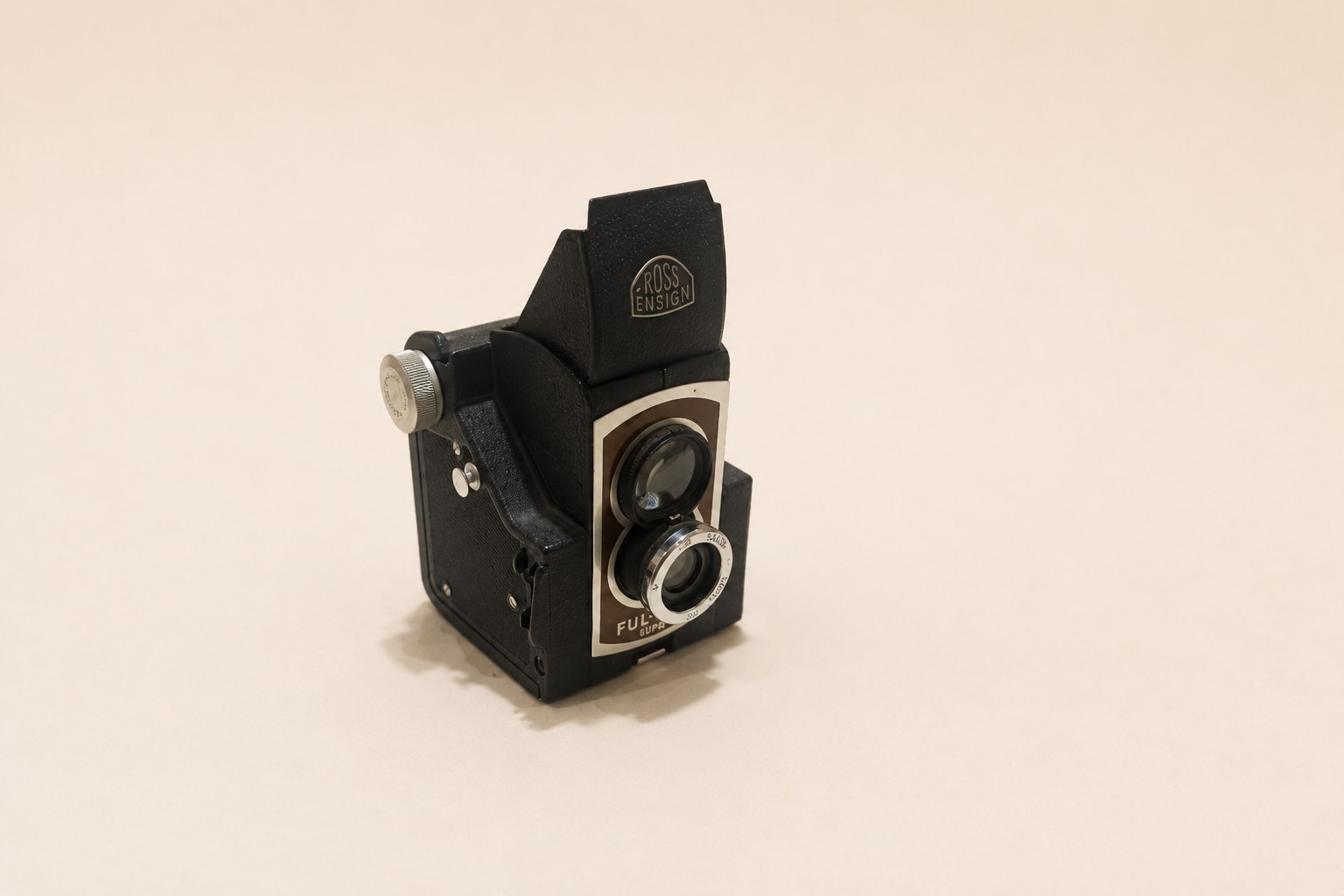
Ensign Ful-Vue Super Camera
The camera that taught Britain to look down, not through: a 1954 Ross Ensign pseudo-TLR with a glowing waist-level finder, one shutter speed, and a lineage reaching back to Daguerre's London licence of 1839.
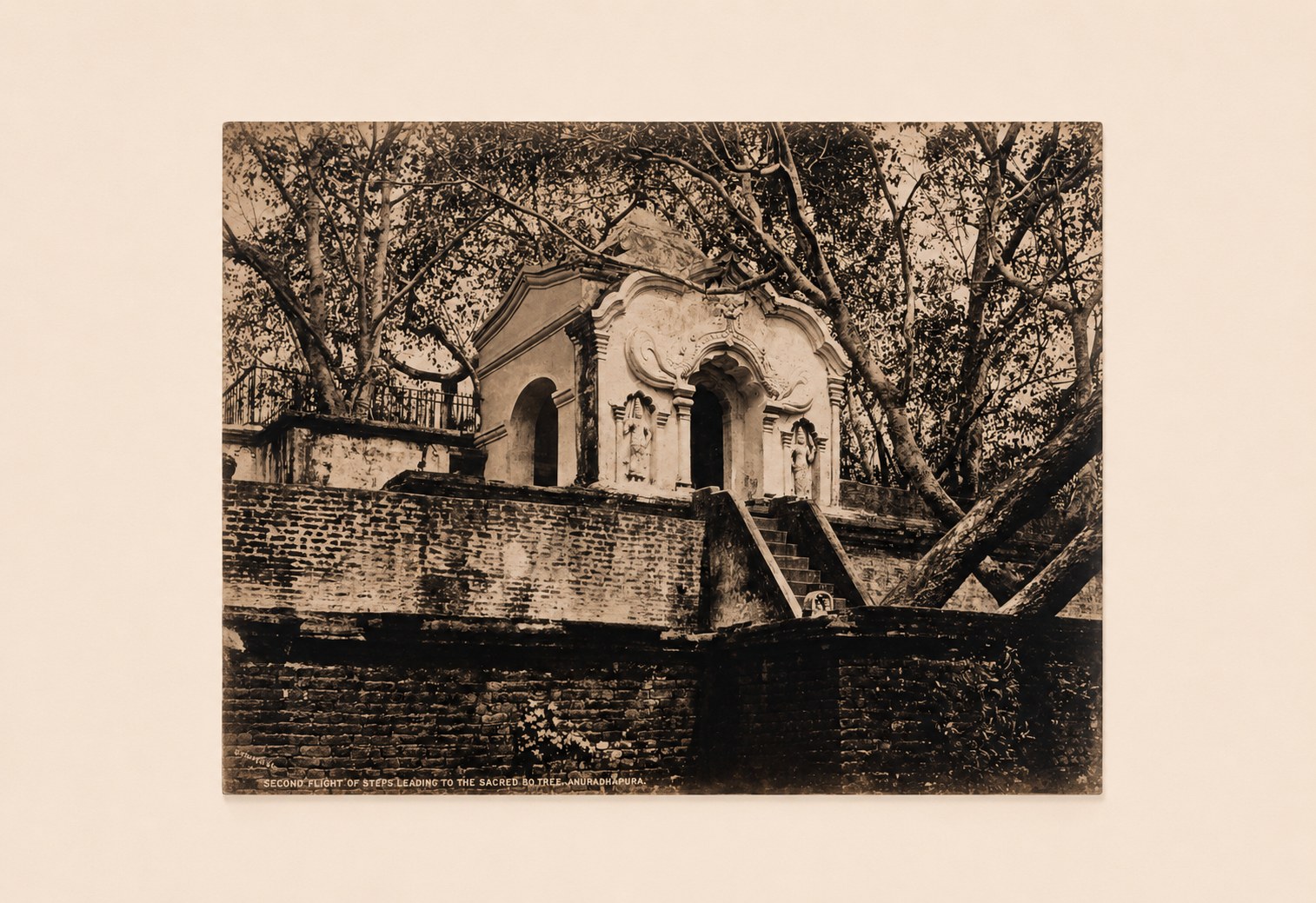
Sacred Bo Tree, Anuradhapura
A Scowen & Co. albumen view of the terraced steps to the Sacred Bo Tree at Anuradhapura — the oldest human-planted tree on earth with a recorded planting date.
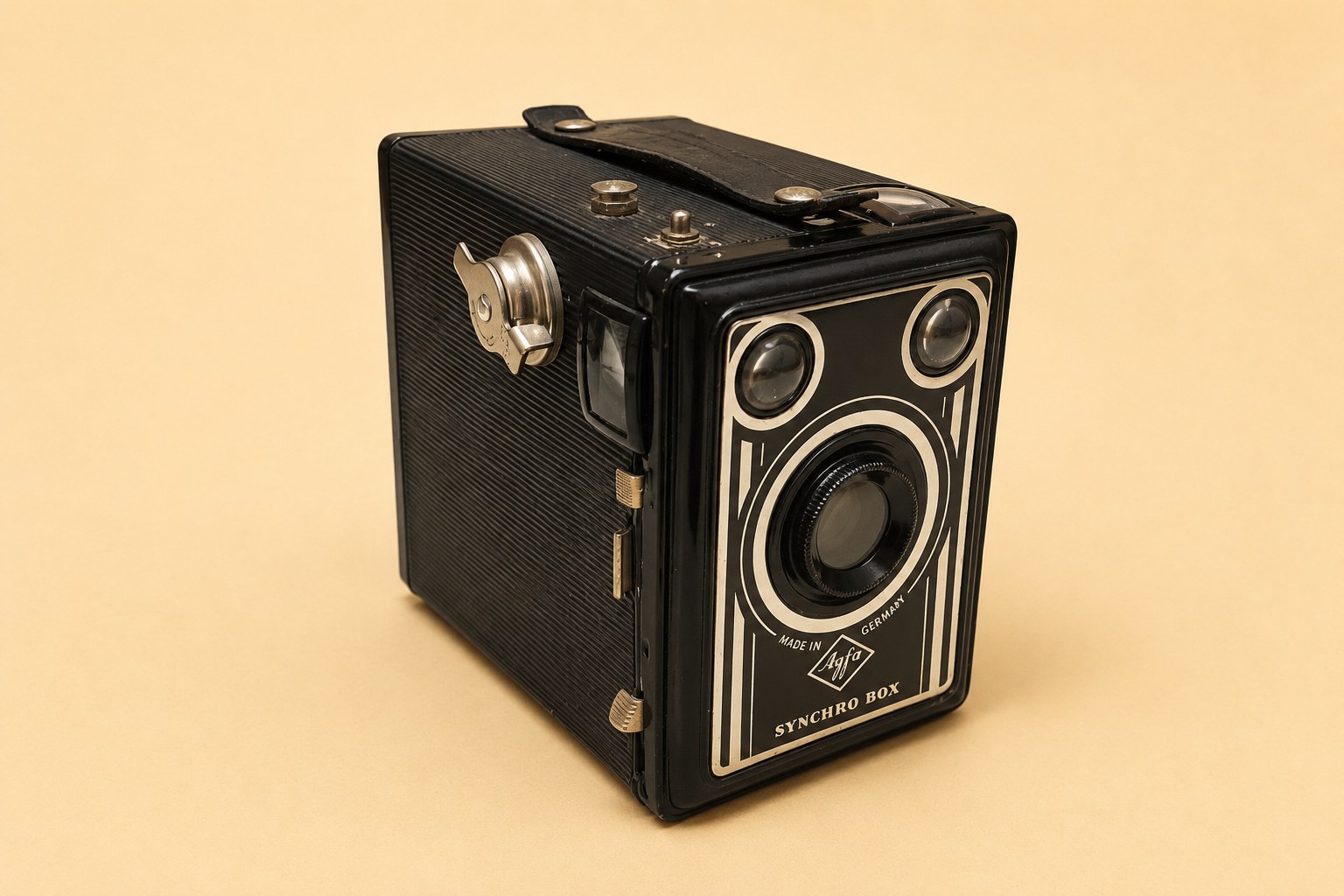
Agfa Synchro-Box
A German 1950s box camera, complete with its multilingual manual — and found still loaded with an exposed, undeveloped roll of Fuji Provia slide film, a ~20-year-old mystery awaiting the lab.