In 1891, a photograph was something you bought. In 1954, a photograph was something you took. Between those two dates the entire meaning of the act reversed, and this collection happens to hold an object from each end of the turn — the last age in which seeing was a service you paid a professional to perform, and the first in which it had become a thing any family simply did.
Start with the buying. A visitor to Bremen in 1891 who wanted to carry the city home walked into a shop and purchased Ernst Roepke's Album von Bremen: twelve albumen silver prints — the Rathaus, the Roland statue, the Börse, the Bleikeller, the Freihafen, the Marktplatz — mounted on stiff card and bound as an accordion-fold leporello with the title stamped in gilt. The negative numbers, 2284 to 2295, give the whole game away. These were industrial products, printed by the hundred from a publisher's stock up in Wiesbaden. Photography in 1891 was a profession with a chemistry of silver and albumen, plate cameras, a printing works, and trained hands behind it. The tourist's entire role was to choose a view and to pay.
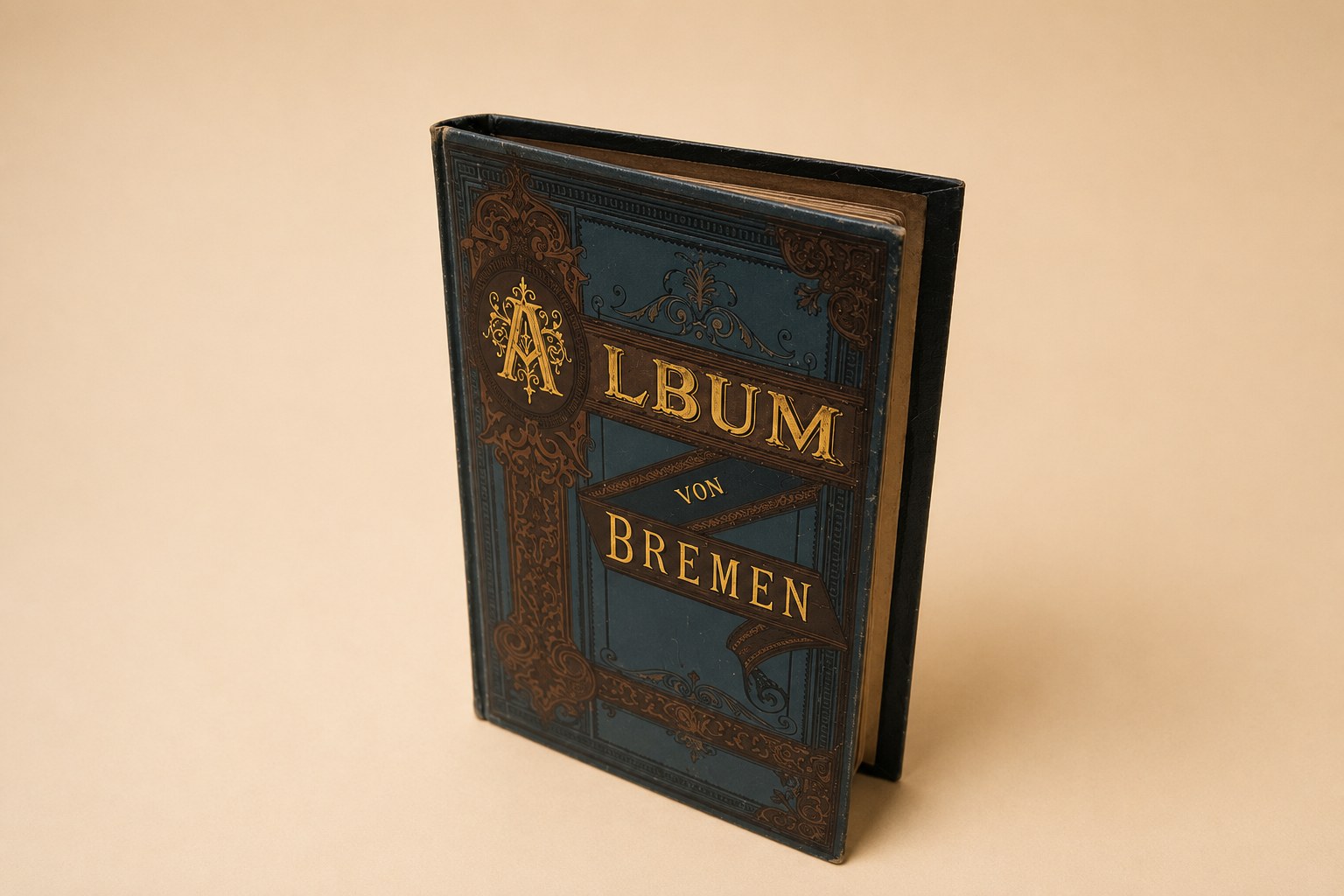
Twelve egg-white photographs of a city the bombs later erased: an 1891 concertina-fold souvenir of Hanseatic Bremen, including monuments that became UNESCO World Heritage 113 years after the shutter clicked.
View object →In 1891 a photograph certified a public place. In 1954 it certified a private life.
Now the taking. By 1954 the Ross Ensign Ful-Vue Super had been engineered with one goal: to let an ordinary family do, on a beach or at a birthday party, what Roepke's studio had once done for an entire city. Cast alloy body, a single 75mm meniscus lens fixed at f/11, a one-blade shutter firing at roughly a fiftieth of a second — nothing about it asked for skill, and that was the point. Its defining feature is the enormous brilliant viewfinder on the top plate: you look down into it, the scene composes itself bright and square before your eyes, and you press. The only Ful-Vue made for 620 film, it sold in enormous numbers precisely because it demanded nothing of the person holding it.
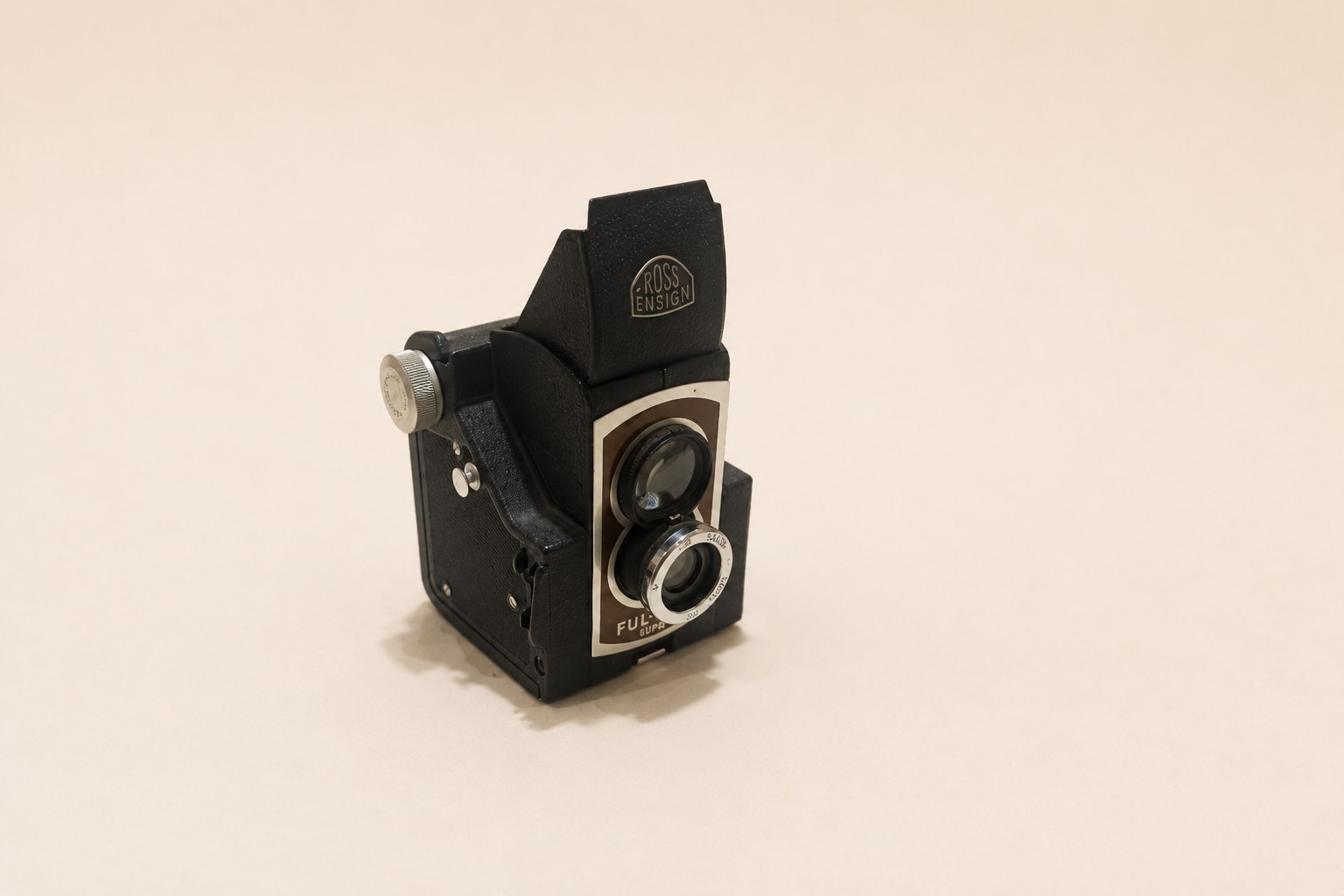
The camera that taught Britain to look down, not through: a 1954 Ross Ensign pseudo-TLR with a glowing waist-level finder, one shutter speed, and a lineage reaching back to Daguerre's London licence of 1839.
View object →Sixty-three years lie between the album and the camera, and across them the whole purpose of a photograph turns inside out. In 1891 the picture certified a public monument: here is the famous Rathaus, the identical view sold to every visitor who came through the door. In 1954 the picture certified a private life: here is our holiday, our child, our afternoon — an image that exists nowhere else on earth and matters to perhaps four people. The album is photography as monument, grand and impersonal and bought. The camera is photography as memory, small and particular and made.
The handover those two objects bracket is one of the quiet revolutions of modern life. Seeing stopped being a service rendered by experts and became a birthright exercised by everyone, and the visual record of the world tilted, all at once, from the public and the official toward the domestic and the dear. This collection keeps both ends of that pivot on the same shelf: the last great age of the professional view, and the first ordinary morning when an untrained hand looked down into a bright little window and kept the day.