Books & Literature
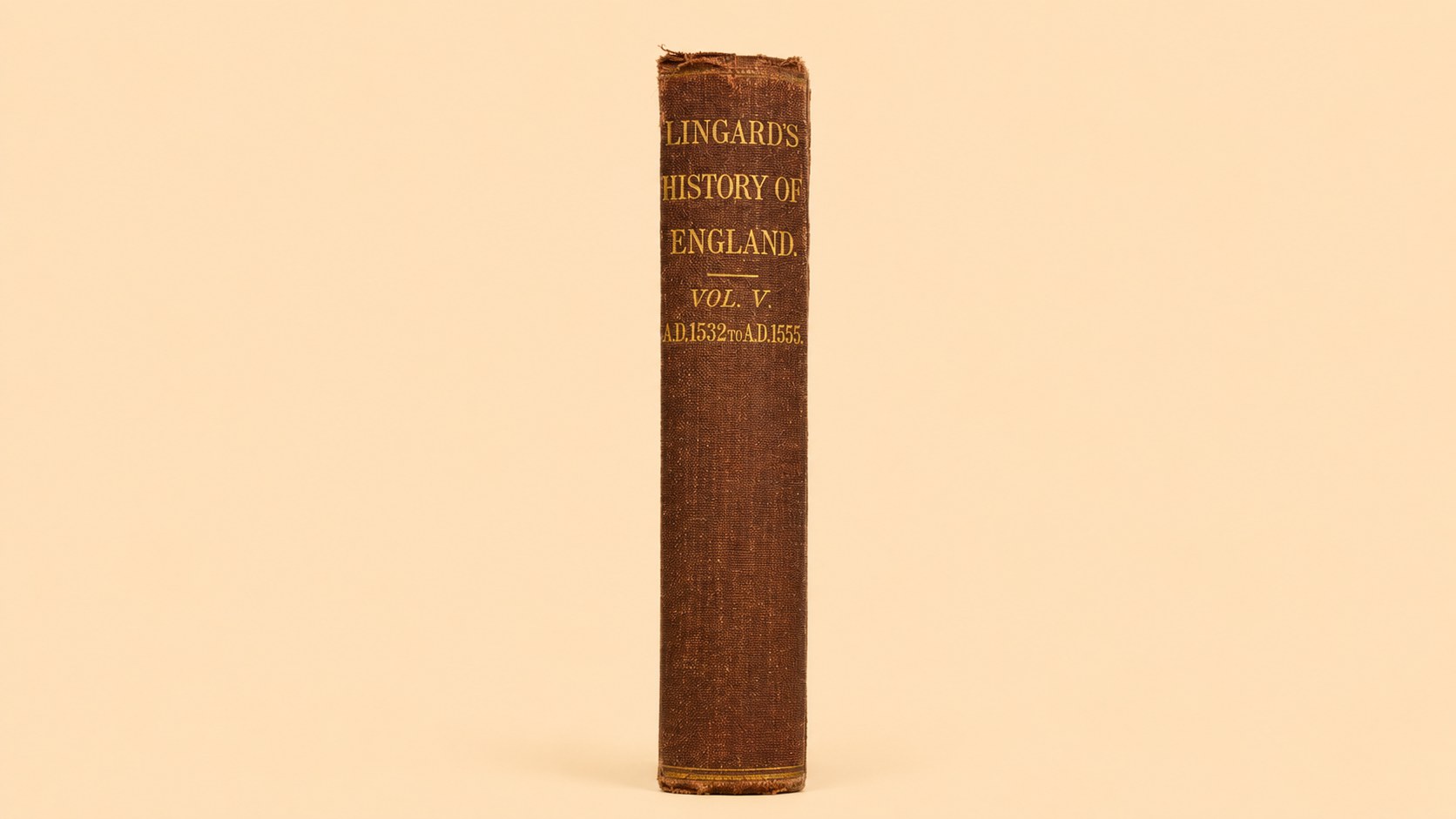
Lingard's History of England, Vol. V
Volume V of Lingard's history — the Reformation head-on: the break with Rome, the dissolution of the monasteries, and the see-saw of Henry, Edward and Mary.
A Private Archive of Antiques & Historical Objects
Books & Literature
Volume V of Lingard's history — the Reformation head-on: the break with Rome, the dissolution of the monasteries, and the see-saw of Henry, Edward and Mary.
The volume the whole History was written for. If Lingard's life's work had a single target it was the English Reformation, and here he meets it head-on — the break with Rome, the seizure of the monasteries, and the violent religious see-saw of Henry, Edward, and Mary.
The collapse of the king's "great matter" into schism: the Submission of the Clergy, the Act of Supremacy of 1534 making Henry Supreme Head of the Church of England, and the executions of those who refused the oath — Thomas More and Bishop John Fisher — in 1535; the Dissolution of the Monasteries and the great northern rising against it, the Pilgrimage of Grace (1536); the later years of Henry VIII; the doctrinally Protestant reign of the boy-king Edward VI, with Cranmer's Books of Common Prayer; and the Catholic restoration under Mary I, to about 1555.
This is where Lingard's method becomes an argument. His avowed theme was "the disastrous effects of the Reformation," yet his technique is the opposite of polemic: he lays out the documents — the suppressions, the inventories of seized monastic wealth, the trials — and lets them speak. Scholars still debate whether the result is history or apologetics; what is not in doubt is that he gave the Catholic reading of the Reformation its first rigorously sourced English statement, forthright enough that William Cobbett drew on it for his own History of the Protestant Reformation. It is also the volume that most provoked his Whig critics, who, like Macaulay, dismissed him as "an advocate."
No volume in the set is more central to its author's purpose, or more contested. Here the History's great wager — that impartiality of method could carry a Catholic case more persuasively than any amount of advocacy — is tested on the most disputed ground in English history. It is the heart of Lingard's project, and a direct scholarly ancestor of the popular Catholic counter-history that Chesterton would later write.
Provenance
Sixth Edition; Charles Dolman, London, 1854–55. One of nine volumes held of the ten-volume set (the set lacks only Vol. IX, A.D. 1660–1680). No ownership inscription noted. Part of a 27-book lot acquired February 2026; cost in the Ledger.
England South
Forty years of sketch-books opened in the year England needed them most: the first volume of Sydney R. Jones's illustrated journey through the southern counties, from London to the very end of Cornwall (1948).
England West
The trilogy's longest journey: Thames to Hadrian's Wall through Cotswold wool churches, Shakespeare country, the Marches, and the industrial North. The richest of the three volumes in architectural range (1950).
England East
The farewell volume: Jones closes his life's work with a journey from the Thames to the Scottish border, saluting Durham coalminers alongside Northumbrian castles, under an epigraph about ashes and graves (1954).